Web3 Game Development: How to Ship On-Chain Game Economics in 2026
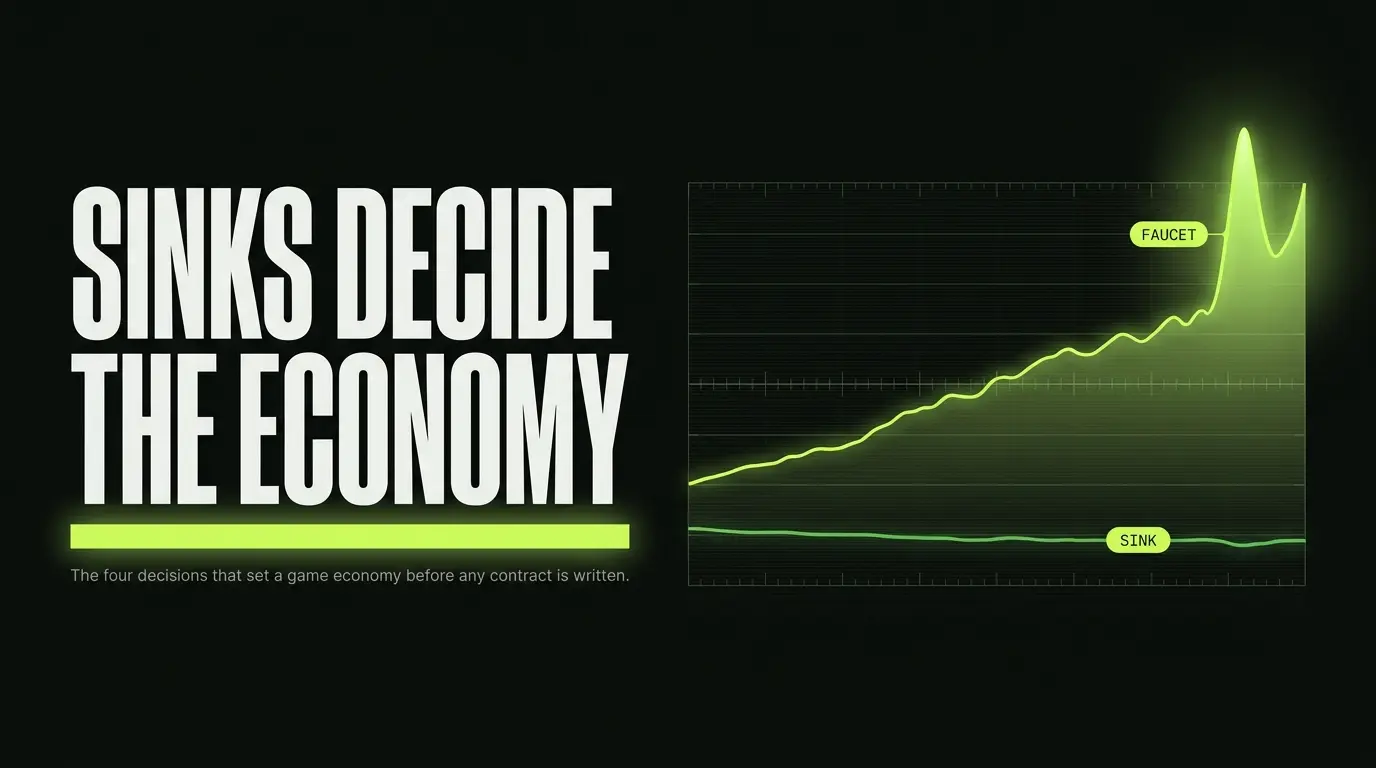
Your playable build shipped on a Tuesday, the token went live that week, and by week three, players were earning rewards faster than the game removed them. The price fell, and the treasury you set aside to defend that price was nearly gone by month’s end. Nobody wrote a bad contract. Nobody modeled the emission schedule either.
That is how Web3 game development usually fails. The studio built exactly what the scope asked for: contracts that mint on command, a marketplace, and a wallet flow. A Web3 game development company will build whatever economy you specify, and the specification is the document nobody wrote. The economy is a design document, not a contract feature.
Most hiring guides tell you who should build your game, and so does our comparison of Web3 game development companies. Almost none of them explain what breaks after launch.
This scoping guide is for founders and technical leads with a playable build and an unfinished economy. It covers four decisions to make first, the ledger that tests them, how the build and audit get priced, and the red flags to raise before signing.
Key Takeaways
- New daily token supply is emission per action times daily actions per player times active players, and the tokens your sinks miss inflate the economy.
- If players never trade with each other, a token gives the game nothing and adds an audit, a regulatory question, and a price chart.
- Economy design, contract build, and audit are three separate purchases, so a vendor quoting one number has combined at least two of them.
- Check the sink ledger against the built game in the thirty days before mainnet, since sinks are easy features to cut late.
Table of Contents
- What “Web3 Game Development” Actually Means in 2026
- The Four Economic Decisions to Settle Before You Hire a Web3 Game Development Company
- Faucets and Sinks: The Ledger Every On-Chain Economy Needs Before Launch
- Why Play-to-Earn Economies Collapsed, and What Replaced Them
- How We Model a Game Economy Before Contracts Are Written (Methodology)
- How a Web3 Game Development Company Prices the Build and the Audit
- Custom Contracts vs. Game-Chain SDKs vs. Off-Chain Ledger, Compared
- Seven Red Flags in a Web3 Game Development Company Quote
- The Thirty Days Before Mainnet: What to Verify
- Conclusion
- FAQs
What “Web3 Game Development” Actually Means in 2026
A Web3 game development company is a studio that designs the on-chain economy, writes and deploys the contracts that hold player assets, and builds the client that reads them. A game with a token is not a Web3 game. A game where the chain controls supply is one.
You decide which in-game assets are minted, which balances are authoritative on a public chain rather than in your database, and which player actions are recorded on chain. Contracts control the supply of what players earn, spend, and trade, so the contracts are the economy. Specify the economy before anyone codes.
If you want the build side, from token infrastructure to wallet flows, our Web3 development practice covers it.
Where a Web3 game studio sits against a traditional one
Art, engine work in Unity or Unreal, level design, and live operations still take most of the hours, and adding a token changes none of that work.
What changes is the asset layer. It becomes a public database with an irreversible history, and a balancing patch becomes a contract upgrade, possible only if you built an upgrade proxy, since smart contracts are “immutable by design,” per ethereum.org’s guide to upgrading smart contracts. A studio that calls itself a blockchain game development company may only add a chain to someone else’s design. Ask which you are buying.
DappRadar’s State of Blockchain Gaming Q3 2025 counted an average of 4.66 million daily unique active wallets for gaming, 25 percent of all active wallets, up from 20.1 percent in Q2 2025. DappRadar then announced its shutdown in November 2025, a month after that report.
The Four Economic Decisions to Settle Before You Hire a Web3 Game Development Company
Four decisions set the contract scope, audit bill, and failure risk of an on-chain game. You own them, even if the vendor runs the numbers.
Decision one: what actually lives on chain
By default, assets players trade go on chain, while progression state, such as experience points and quest flags, stays off it. The question for the call is which balances must be authoritative on chain and which can sit in a normal database.
Too much on chain costs transaction fees and latency on every action. Too little leaves players doubting the token is scarce.
How much you put on chain also sets scope, since every on-chain balance adds contract code, and audit firms commonly price by lines of code.
Decision two: one token, two tokens, or none
Ask what the token does that a database entry cannot. If players never trade with each other, the honest answer is nothing, and skipping the token is a legitimate design.
Axie Infinity ran the best-known dual-token model. AXS is scarce and carries governance, while SLP is the soft currency, earned and burned daily, so the daily inflation lands on SLP rather than on AXS holders. A hard currency, the one players buy rather than earn, gives its issuer seigniorage, or minting profit, but only while players still want the currency.
A dual-token model also means two supply curves to balance and two faucets for bots to farm. DeSpread Research’s study of Web3 game tokenomics argues in-game tokens are rarely necessary, and points to cosmetic-only rewards and a single-token model like Echelon Prime’s PRIME.
Decision three: who mints, and at what rate
A faucet is any mechanism that creates new supply, and its rate is a design parameter, not an emergent property. Ask for the daily emission and the arithmetic behind it.
New daily supply equals emission per action, multiplied by actions per player per day, multiplied by active players. These numbers are illustrative, not client figures. At 10 tokens per win and five wins per player a day, 20,000 active players mint 1,000,000 new tokens daily. Double the players, and emission doubles, whether or not demand does.
Plan for bots here, since a bot repeats the rewarded action all day. The designs that last pay from a fixed seasonal pool tied to competitive ranking, rather than paying for every repeatable task.
Decision four: what removes supply
A sink is any mechanism that permanently removes supply, and a cosmetic players resell on the NFT marketplace is not one. Four types work:
- Crafting burn: A burn mechanic that destroys currency to make something new.
- Entry fees: Charges for competitive modes, burned rather than paid out.
- Repair and durability: Gear that wears out, with repairs that burn currency, one of STEPN’s own burn mechanisms.
- Fee-on-transfer: A cut of every marketplace trade, burned at sale.
Once the game is running, sinks must remove at least as much as faucets create, or the price falls however good the game is.
Then ask who can change the emission rate after launch and whether that takes a contract upgrade. OpenZeppelin’s access control documentation notes that access control can govern who can mint tokens, so the answer should be a named role, not a promise. Answer all four decisions before you book a vendor call.
Faucets and Sinks: The Ledger Every On-Chain Economy Needs Before Launch
A sink ledger lists every mechanism that creates supply and every mechanism that destroys it, with a rate against each. It turns on-chain game economics from a pitch deck into arithmetic.
The example uses illustrative rates per active player per day, not a client model. One row only moves tokens.
| Mechanism | Type | Tokens per active player per day | What changes the rate |
|---|---|---|---|
| Match win reward | Faucet | 50 created | Reward per win, win cap |
| Crafting burn | Sink | 20 removed | Recipe cost |
| Ranked entry fee | Sink | 10 removed | Fee per entry |
| Repair and durability | Sink | 12 removed | Wear rate per match |
| Marketplace fee to treasury | Transfer | 3 moved | Fee rate, share burned |
Those mechanisms create 50 tokens and remove 42, a net 8 per player per day. The row studios forget is the marketplace fee. That fee counts as a sink only if a burn mechanic destroys it, since the treasury spends the rest back out.
EVE Online is the longest-running example. DeSpread’s tokenomics study puts EVE’s ISK supply at roughly eight times its 2003 level, while US dollar M2 grew about fourfold since the early 2000s. CCP Games publishes a Monthly Economic Report, such as the July 2026 edition on money supply, and your studio needs the same monthly habit.
NFT game development adds a second ledger for in-game assets. Burning an NFT removes it, while delisting only hides it until it returns to the NFT marketplace. An NFT game development company that mints items with no burn path has built a faucet with no drain beneath it.
A game economy fails when faucets create more than sinks remove, and the ledger shows that gap before players find it in the price. Scope the contracts only after the ledger exists.
Why Play-to-Earn Economies Collapsed, and What Replaced Them
Play-to-earn paid players in a token whose main buyers were new players, so every reward was a debt the game owed rather than money it spent. When new signups slowed, minting kept running, and nothing removed the tokens it created.
Axie Infinity’s January 2022 dev journal on economic balancing said SLP creation “has consistently outpaced its use” and called the inflation “not sustainable.” STEPN’s own tokenomics post said “the supply of GST is unlimited,” and Naavik’s July 2022 analysis recorded a GST price drop of more than 95 percent as fewer new players joined.
CoinGecko’s GameFi study looked at 2,817 Web3 games launched from 2018 to 2023 and found 2,127 inactive by November 2023, or 75.5 percent. The token was not the problem. The missing sink was.
What replaced play-to-earn is a set of mechanisms, not a new label: cosmetic-only rewards, seasonal competitive pools, and ownership that lets players take items elsewhere. DeSpread goes further, calling sustainable faucet-and-sink design “almost impossible” once tokens trade freely and bots can farm them, and pointing to closed economies that pay seasonal rewards.
Today’s reward is a cosmetic or a ranking prize, not a cash-out.
How We Model a Game Economy Before Contracts Are Written (Methodology)
We model the economy as its own deliverable, dated against your launch, in six steps:
- Before any scope: The on-chain list, naming which balances live on chain.
- Before contract design: The emission schedule, faucet by faucet, with the arithmetic shown.
- In the same window: The sink ledger, with a rate per mechanism and a net figure per player.
- Before the audit quote: The audit scope built from those three documents, economic logic included.
- Thirty days before mainnet: The ledger checked against the game as built.
- Every month after launch: An economic review against live data.
Discovery ends with four documents: the on-chain list, the emission schedule, the sink ledger, and the audit scope. One limit matters. A model built before launch is a guess until bots test it, so review it monthly.
If you are hiring individual engineers, use a founder’s 12-point vetting checklist. For a shortlist of general build partners, see the wider Web3 development company comparison.
Our wider record covers more than 300 projects supported worldwide, for teams including Oracle Red Bull Racing, Seedify, and REKT. Our limit is scale because a small senior team does not staff a forty-person build. We are a Web3 game development company in the USA, based in Baton Rouge, Louisiana, so your calls land in US Central Time rather than overnight.
How a Web3 Game Development Company Prices the Build and the Audit
The economy design, the contract build, and the audit are three separate purchases, and a vendor quoting one number has combined at least two of them. Ask for three lines.
- Economy design: The line most quotes omit. Price the ledger, the schedule, and the on-chain list as a named deliverable, not a sub-bullet.
- Contract build: Priced by how much lives on chain. For the wider cost logic, see what actually drives dApp development costs.
- Audit: The audit sits outside the build budget. It is a separate engagement that starts after the code is finished, and its scope should name the economic logic.
Sherlock’s 2026 audit pricing reference prices audits by lines of code, yet still quotes a range for a simple ERC-20 token, so halving your contracts will not halve the bill. CertiK’s Hack3d report counted 240 code-vulnerability incidents in 2025. Our smart contract audit page covers that separate engagement.
Three running costs stay out of the quote and never stop:
- The indexer: A service such as The Graph that lets your game search on-chain events.
- The RPC provider: The remote procedure call (RPC) endpoint every read and write passes through.
- The relayer or paymaster: The service behind gasless signup, since ERC-4337 account abstraction lets one contract pay the player’s fee.
Get all six cost lines in writing before you compare.
Custom Contracts vs. Game-Chain SDKs vs. Off-Chain Ledger, Compared
Three build routes cover most on-chain games, each trading control for speed. Every quote for NFT game development services assumes one of them, so ask which.
| Route | What you own | Time to first mainnet transaction | Audit scope | What goes wrong |
|---|---|---|---|---|
| Custom contracts on an Ethereum Virtual Machine (EVM) chain or Solana | Every contract and its upgrade keys | Slowest | Largest, every contract plus economic logic | Every bug is yours |
| Game-chain SDK on Immutable, Ronin, or an Avalanche subnet | Your contracts, on a chain someone else runs | Faster, with tooling supplied | Smaller, your own contracts and economic logic | You inherit the chain’s economics and upgrade calendar |
| Off-chain ledger with periodic on-chain settlement | Every balance, in your database until settlement | Fastest | Smallest, the settlement contract | Players own nothing between settlements |
Custom contracts, the route we build, are right when the economy itself is the product. EVM teams commonly use OpenZeppelin with Foundry or Hardhat, and their web clients read chain state through wagmi and viem. Solana teams write programs in Rust, often with Anchor.
A game-chain route ships faster and needs a smaller audit. Immutable’s gas sponsorship documentation says Immutable sponsors gas costs for all Passport users, so players never see fees and you build less wallet code. You also follow the chain’s upgrade schedule. Ronin finished moving to an Ethereum Layer 2 in May 2026, and an Avalanche subnet is now branded an Avalanche L1 after the Etna upgrade.
The off-chain ledger is the cheapest, most flexible route, and your terms of service should say players hold nothing between settlements.
Artemis data reported by CoinDesk put Ethereum at 2,811 weekly active developers against Solana at 942 in March 2026. Build where your players already hold assets, and then count the auditors who work in that chain’s language, since Rust and Move audits cost more than Solidity audits, per Sherlock’s pricing reference. If a Solana blockchain development company pitches you, read why Solana, Move, and EVM audits are not the same job first.
Seven Red Flags in a Web3 Game Development Company Quote
A weak quote leaves out the economy, whether it covers a full build or only NFT game development services. Each flag comes with a line to say on the call.
- Contracts priced, economy left out: No word on emissions. Say, “Which document did you read to produce the emission schedule?”
- An audit mentioned but not priced: Security appears without its own line. Say, “Show me the audit as a separate line item.”
- A chain picked for the studio’s skills: The chain suits the vendor’s staff, not your players. Say, “Where do my players hold assets today?”
- No owner for the emission rate: Nobody can name the person or role that can change it after launch. Say, “Which address or role can change emissions?”
- Screenshots without contract addresses: Trailers and art only. Say, “Send me the block explorer link for that deployment.”
- Tokenomics as a slide: A pie chart, not a ledger with rates. Say, “Send me the sink ledger.”
- No post-launch economic review: The first real bot wave arrives after mainnet, not in staging. Say, “Who reviews the economy in month one?”
One of these is worth a question. Three should end the call.
The Thirty Days Before Mainnet: What to Verify
Use the last thirty days before mainnet to check the economy against the game you built, not the design document.
- The sink ledger: Features get cut late, and sinks are easy to cut, so recheck every row against the build.
- Emission parameters: Confirm that they are readable on chain and that changing them follows a named, contracted process.
- Audit coverage: An ERC-compliant contract can still mint on a broken schedule, so confirm the report covers economic logic, using a buyer’s guide to smart contract audit scope.
- The monthly report: Name its owner before launch, not after the first problem.
- Three permissions: Repository ownership, deploy rights, and the keys that change emissions transfer separately, and a vendor can keep any one after handover.
Ship when every line checks out.
Conclusion
The economy is a written design, priced and audited separately from the build. The treasury in your opening month did not run dry because a contract failed. It ran dry because nobody wrote down what creates and removes supply, at what rate, and who can change it.
Build the ledger. Name every sink. Price the audit on its own line. Ask who can change the emission rate. Do that before you sign, and the Web3 game development company you hire builds an economy you have already modeled on paper.
If you want a written economy model before you price the build and the audit, book a free 30-minute game-economy architecture review with Web Three Consulting. We’ll map your faucets and sinks, write out the emission arithmetic for your core loop, and list what your audit has to cover. If you don’t need a token, we’ll say so.
FAQs
What does a Web3 game development company actually build?
Three things, and only one of them is the game. A Web3 game development company designs the on-chain economy, writes and deploys the contracts that hold player assets, and builds the client that reads them. Art, engine work, and level design match any other title. The economy work is the part quotes skip.
Does my game need a token?
Often no, and that answer saves the most money. A token earns its place when players trade with each other and something outside your database has to cap supply. Without a player-to-player economy, a token returns nothing and adds an audit, a regulatory question, and a price chart. Decide this before you scope contracts.
What is the difference between a Web3 game and a normal game with NFTs?
Authority over the assets. In a Web3 game, the contracts decide what exists and who holds it, so a public chain, not a studio server, enforces supply. A normal game with NFTs mints collectibles while its own database still holds the real record. The first is an economy. The second is merchandise.
How much does the on-chain layer cost to build?
Mostly scope, not hours. Economy design, contract build, and audit are three separate purchases, and the number moves most with how much game state has to be authoritative on chain. A quote with a single total has usually combined at least two of the three. Ask what it covers before comparing it.
Why did play-to-earn games collapse?
Supply outran demand. Rewards were paid in a token whose buyers were mostly new players, so every reward was a debt the game owed, not a marketing cost. When new signups slowed, minting kept running, and nothing removed the supply it created. CoinGecko’s 2023 GameFi study found 75.5 percent of Web3 games inactive.
Which chain should a Web3 game launch on?
The one your players already hold assets on. Close calls come down to cost per transaction at your expected volume and how many auditors work in each chain’s contract language. Rust and Move audits cost meaningfully more than equivalent Solidity audits, which makes the chain choice a budget decision at your volume, not a preference.
Does the game economy need its own audit?
Yes, as its own line in the audit scope. A contract can pass every ERC token-standard check and still mint on a schedule that breaks the economy within weeks. Ask for the audit to be quoted apart from the build, scoped to the emission schedule, and started after the code is finished.
Who controls the economy after handover?
Whoever holds the keys, so name the key holders in writing before work starts. Name three separate permissions: repository ownership, deploy rights, and custody of the keys that change emission parameters. A studio can retain any one of them after handover. Put all three in the statement of work instead of assuming they transfer automatically.