Best Web3 Game Development Companies in 2026: A Founder’s Comparison
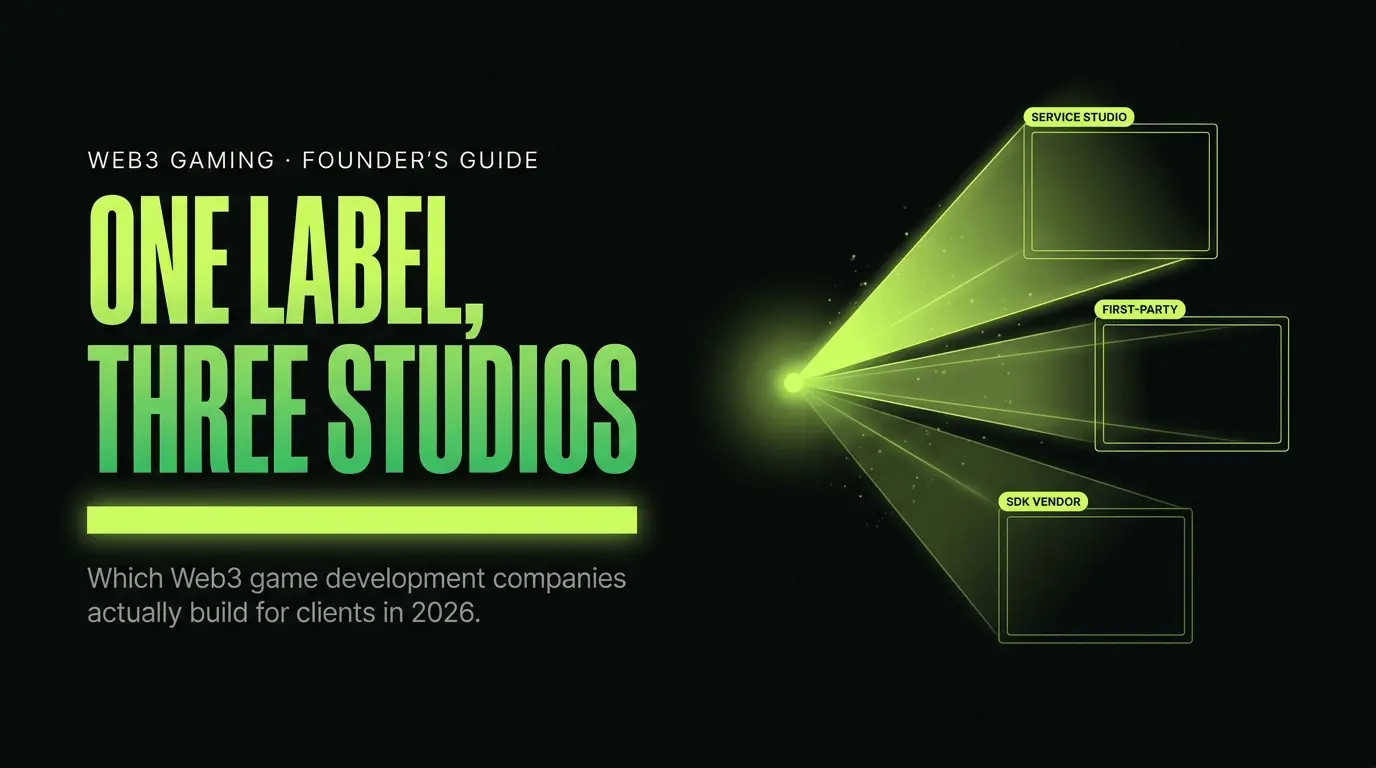
You email a dozen studios on Monday, off a ranked list of Web3 game developers, with a Unity prototype and a fresh seed round. By Friday, you have three replies. One studio builds only its own titles, one sells you a software development kit (SDK) instead of a team, and one sends trailers for games you cannot download. Three replies, three different businesses.
Nothing on that list was false. It filed three kinds of company under one label, and only one kind is a Web3 game development company you can hire: a studio that builds your game and hands it back. Moralis’s list of 36 top Web3 game studios runs STEPN, Illuvium, Dapper Labs, and a Unity SDK down one column, as if you could hire any of them. You cannot.
We are on that list ourselves, at entry one, for the on-chain layer only. Every outside studio below clears two checks: it takes client work, and it credits a live Web3 title we could open ourselves. That test cut more than 30 companies to four.
This is a hiring comparison for founders and publishers, not a ranking for players or investors. You get four studios, price bands, and the questions to ask on the first call. If you need a general Web3 build partner rather than a game team, start with our comparison of dApp development companies.
Key Takeaways
- The best Web3 game development companies in 2026 are service studios such as Stepico and iLogos, not first-party studios such as Sky Mavis, which take no client work.
- No outside studio made this list without a shipped, playable Web3 title you can open today, and four of the more than 30 we checked passed.
- A studio that quotes the token economy as one line item at the end of the scope of work has not designed one.
Table of Contents
- What “Web3 Game Development Company” Actually Means in 2026
- Three Things People Call a Web3 Game Development Company (Only One Will Build Your Game)
- Token Economy Design: Why Most Web3 Games Die (and What a Good Studio Does About It)
- How We Evaluated Web3 Game Development Companies (Methodology)
- The Best Web3 Game Development Companies in 2026 (Compared)
- Web3 Game Development Pricing: What You Should Expect to Pay in 2026
- Red Flags: How to Spot a Bad Web3 Game Development Company
- 7 Questions to Ask Any Web3 Game Development Company Before You Sign
- DIY vs. Studio vs. Hybrid: Which Engagement Model Fits Your Game?
- US vs. Offshore Web3 Game Studios: What Actually Changes
- Use Cases and Examples
- Conclusion
- FAQs
What “Web3 Game Development Company” Actually Means in 2026
A Web3 game development company is a service studio that builds games for clients, integrates on-chain assets or a token economy, and hands the finished game back to the client. It builds your game, not its own, and that distinction clears out much of every ranked list.
Web3 game development services cover three layers: the game (engine, art, and gameplay), the on-chain layer (asset contracts, wallet, and marketplace), and the economy (how currency enters and leaves, and whether a token exists). Firms selling only blockchain game development services cover the middle layer.
What is Web3 gaming? It is ordinary gaming in which players can trade some items or currency on a public blockchain. Because those items carry cash value, a leaky economy costs players real money.
Web3 game vs. NFT game vs. play-to-earn: three labels, one buyer
A Web3 game is any game with on-chain assets, accounts, or currency, including wallet sign-in through account abstraction and inventories held in ERC-6551 token-bound accounts. An NFT (non-fungible token) game is the subset whose items are tokens, usually under the ERC-721 standard for one-of-one items or ERC-1155 for stackable ones. An NFT game development company is usually the same kind of studio relabeled, so ask what it shipped.
Play-to-earn, or P2E, pays players tradable rewards for playing, and most studios dropped it after 2022. A studio still branding itself a play-to-earn game development company is selling the last cycle.
Same buyer, three labels. Use the one your studio understands.
Three Things People Call a Web3 Game Development Company (Only One Will Build Your Game)
A first-party Web3 game studio keeps its titles, while a Web3 game development company hands yours back.
First-party Web3 gaming companies, such as Sky Mavis, Mythical Games, and Dapper Labs, publish their own titles and sell no build team. Infrastructure and SDK providers sell chains or tooling, such as Immutable Chain (Immutable zkEVM), Sequence (which Polygon Labs is acquiring), the ChainSafe Gaming SDK for Unity, and Alchemy’s gaming application programming interfaces (APIs).
The table compares all three, as checked in September 2026.
| Kind of company | Examples | What you can buy | Typical engagement | Price signal |
|---|---|---|---|---|
| First-party Web3 game studio | Sky Mavis, Mythical Games, Dapper Labs, Gala Games, and Illuvium | Nothing | None for clients | Not applicable |
| Infrastructure or SDK provider | Immutable, Sequence, ChainSafe, and Alchemy | Chains, wallets, SDKs, and APIs | Self-serve or platform deal | Set per product |
| Web3 game development company | Stepico, iLogos, Whimsy Games, and Kevuru Games | A finished game, or the layer you lack | Fixed scope, co-development, or dedicated team | Rarely published |
Email the third row only.
Token Economy Design: Why Most Web3 Games Die (and What a Good Studio Does About It)
Most Web3 games fail at the economy, not the code. The category is smaller, not dead, and DappRadar’s Q3 2025 gaming report, published a month before the tracker announced its shutdown, counted 4.66 million daily active wallets. CoinGecko’s research on dead GameFi projects found 2,127 of 2,817 Web3 games from 2018 to 2023 inactive by November 2023, a 75.5 percent failure rate.
Every game economy has sources, where currency enters (rewards, minting, and login bonuses), and sinks, where it leaves (crafting fees, burns, and repairs). When sources outrun sinks, the currency acts like a tank with the tap open wider than the drain. A January 2022 Axie Infinity dev journal said creation of Smooth Love Potion (SLP), the game’s reward token, “has consistently outpaced its use” and called the inflation “not sustainable.”
In Web3 game development, the economy has to be designed before the art because once reward rates sit in deployed contracts, fixing inflation can mean redeploying them. A good studio runs an economy simulation before art production, modeling emissions against D1, D7, and D30 retention (players still active on days 1, 7, and 30).
Revenue comes from primary asset sales, a marketplace royalty on secondary trades, and in-game purchases. Token appreciation is not a business model.
For a startup, a Web3 game is worth building only if it would hold players without the token. Economy first, engine second, chain last.
How We Evaluated Web3 Game Development Companies (Methodology)
We checked every company’s website and live store listings against six criteria in September 2026.
- Shipped, playable titles: a Web3 title you can play today, credited on the studio’s site.
- Engine depth: Unity, Unreal Engine 5, or web builds in shipped work.
- Chain and SDK coverage: Immutable, Ronin, Polygon, Base, or Solana work, plus a willingness to argue against a chain.
- Token economy competence: an economy simulation or a published post-mortem.
- On-chain security posture: an independent auditor for asset and marketplace contracts.
- Engagement transparency: published pricing or a documented scoping process.
We excluded any studio with no shipped, playable Web3 title or no client work. DappRadar is now a historical record, so every title was confirmed on a live store or game page. We ignored headcount and directory reviews and scored ourselves on the on-chain layer only.
Several first-page names did not pass:
- Web3 pages now generic: Juego Studios, whose Web3 URLs serve a general game page.
- Credited titles offline or unreleased: Starloop Studios, StudioKrew, and Antier, whose Helium Wars build shows “Coming Soon” on the Epic Games Store.
- Clone scripts, not client games: Gamesdapp and BreedCoins.
- No game in the Web3 portfolio: EvaCodes, BR Softech, and Vegavid.
The Best Web3 Game Development Companies in 2026 (Compared)
The best Web3 game development company for a Unity mobile title and the best for a browser game with a dual-token economy are different studios because engine depth and economy depth rarely share a shop.
1. Web Three Consulting (us): the on-chain layer
Positioning: We build the on-chain layer of a Web3 game (asset contracts, token design, wallet flows, and integrations) for studios with an engine team, and we audit contracts other teams wrote.
Proof: More than 300 projects supported worldwide, for teams including Oracle Red Bull Racing, Seedify, and REKT.
Strengths: Audit work in Solidity, Rust, and Move means we write contracts knowing how they get attacked.
Pricing: Scoped per project, with market bands in the pricing section.
Engines and chains: Engine-agnostic, across Ethereum Virtual Machine (EVM) chains, Solana, and Move-based chains.
Best fit: The tradeoff is focus, since we work on the on-chain layer, not the game itself. A fit for a game in production that needs its contracts and token design settled before launch.
2. Stepico
Positioning: A blockchain game development company and co-development studio with offices in New York, Lviv, Limassol, and Sydney.
Proof: Stepico lists full-cycle development of Loaded Lions: Mane City, a city-building game on the Cronos SDK, and Mane City’s Google Play listing names Stepico Games as developer.
Strengths: Full-cycle builds and blockchain work sit under one roof, so no second vendor bolts on the Web3 layer.
Pricing: Not published.
Engines and chains: Unity and Unreal Engine 5, shipped on Cronos.
Best fit: The tradeoff is scale of proof, since Mane City shows 1,000+ Android downloads. A fit for a founder who wants one vendor for game and chain. Decentraland and The Sandbox on its Web3 page make it the closest here to a metaverse NFT game development company. Less of a fit for a large live-service reference.
3. iLogos Game Studios
Positioning: An external development studio with its listed office in Gibraltar, selling full-cycle builds, co-development, and porting.
Proof: iLogos ported Gods Unchained to iOS and Android for Immutable across 2023 and 2024. The Gods Unchained Android app is live, and the game now runs on Immutable zkEVM.
Strengths: It ported a live game with player-owned cards, where one bug costs players real money.
Pricing: Not published.
Engines and chains: Unity and Unreal, shipped on Immutable’s chain.
Best fit: The tradeoff is that its Web3 credit is a port of someone else’s economy. A fit for a publisher taking a Web3 title to mobile. Less of a fit for economy design.
4. Whimsy Games
Positioning: A London-registered studio selling co-development, outsourcing, and full-cycle builds.
Proof: Whimsy lists full-cycle development of Meegos Mayhem by a team that peaked at 30 people. Built around the 10,000-character Meegos collection, the game is live, and its App Store listing shows an August 2025 update that “Added wallet authorization.”
Strengths: Speed, since the case study records a public release 1.5 months into the build.
Pricing: Not published.
Engines and chains: Unity, Unreal Engine, Godot, and HTML5, with no chain named in its case study.
Best fit: The tradeoff is depth, since the shipped Web3 element is wallet sign-in rather than an on-chain economy. A fit for a Web2 studio adding wallet login fast. Less of a fit for a dual-token economy.
5. Kevuru Games
Positioning: An art-heavy studio in Warsaw, San Francisco, and Dover, Delaware, running its blockchain game development services through the Playloom brand.
Proof: Playloom, whose site footer credits Kevuru Games, produced more than 40,000 avatars for Immutable’s Guild of Guardians, and the game is live on Google Play.
Strengths: Art volume at scale and the only published game rate card here.
Pricing: Published for games in general, not for Web3 layers.
Engines and chains: Unity and Unreal Engine, with Playloom naming Ethereum, Polygon, Solana, and Flow.
Best fit: The tradeoff is that its live Web3 credits are art, not full builds. A fit for a studio that needs NFT art in volume. Less of a fit for an economy or contract build.
Web3 Game Development Pricing: How Studios Price It in 2026
Blockchain game development cost splits into three separately priced layers. Most founders ask for one number and get one number, which is how the token work and the game build end up buried in the same line. Ask for three.
- On-chain layer: The smallest of the three for a simple token project, and the one vendors most often quote alone. Scope drivers are the vesting schedule, the front end, and whether the contracts are written new or forked from an audited base. Senior Solidity staff price by seniority, monthly or hourly, and the audit is billed on top as a share of build cost, per our guide to hiring a Web3 developer. Budget the audit as its own line or it arrives as a change order.
- Game layer: The largest line by a wide margin, and the one that moves most with scope. Kevuru Games’ published rate card, read in September 2026, ties the quote to game type, platforms, features, multiplayer backend, and art scope. A mid-core title prices far above a simple mobile build on that same page. Same studio, different project.
- Economy layer: No studio we checked publishes a figure for it. That silence is the tell. Price it as a named deliverable with a simulation attached, not as a sub-bullet inside the token line.
Red Flags: How to Spot a Bad Web3 Game Development Company
A bad blockchain game development company gives itself away in five ways, each with a real cost.
- Trailers but no playable build: No install link means nothing shipped, and yours becomes its first launch.
- “P2E” headlining the services page: Any play-to-earn NFT game development company still pitching the 2021 model will hand you an inflating currency to fix.
- The chain chosen before the game design: A later chain migration means redeploying every asset contract.
- The economy as a line item: One “tokenomics” row with no simulation means nobody modeled sinks and sources.
- Contracts audited in-house or not at all: A marketplace exploit can get your items delisted, so insist on an independent smart contract audit.
One flag is worth a hard question. Three should end the call.
7 Questions to Ask Any Web3 Game Development Company Before You Sign
- Which of your shipped games is playable today? Worry: a trailer or a confidentiality excuse. Good: an install link.
- Where is the economy simulation for your last title? Worry: “we balance after launch.” Good: a sinks-and-sources model.
- Which chain would you recommend against for this game? Worry: the same chain for every client. Good: a reason tied to wallet onboarding, fees, and your players.
- Who audits the ERC-721, ERC-1155, or ERC-6551 asset contracts and the marketplace? Worry: “our own team.” Good: a named independent firm and a clear view of what a smart contract audit actually covers.
- Who holds the admin keys and the treasury multisig at handover? Worry: the studio. Good: you, in writing.
- What is subcontracted? Worry: a pause. Good: names.
- What happened to the last game you launched that did not work? Worry: “none failed.” Good: a post-mortem.
DIY vs. Studio vs. Hybrid: Which Engagement Model Fits Your Game?
Most Web3 games are built one of three ways, and each breaks somewhere predictable.
- In-house team plus an SDK: Your engine team plugs in Immutable, Sequence, or ChainSafe, often with account abstraction to hide gas fees. The setup breaks when nobody on staff has designed an economy.
- Full-service studio: A Web3 game development agency builds everything. That suits a founder with no team, until the agency’s engine or economy depth proves thin.
- Hybrid: Your engine team builds the game while a specialist handles contracts and economy, a split that blockchain consulting for strategy and delivery can scope. It breaks when nobody owns the handoff.
The hybrid keeps the game yours and puts a specialist on the part most likely to fail. To hire the best Web3 game developers instead of a studio, use a founder’s 12-point vetting checklist for hiring a Web3 developer.
US vs. Offshore Web3 Game Studios: What Actually Changes
A studio’s home country changes contract enforcement, overlap hours, and hourly rate, not engine quality.
- Intellectual property: A Web3 game development company in the USA or EU signs an IP assignment you can enforce at home.
- Overlap hours: LiveOps (live operations) means live incidents, and a studio eight hours away fixes them the next morning.
- Reference checks: Past clients abroad take longer to reach.
Offshore studios hold one real advantage, surge art capacity at a lower rate. Hire for the shipped title and economy competence, then price the time zone.
Use Cases and Examples
The right partner depends on what you are building.
- A Web2 mobile studio adding tradable cosmetics: A hybrid on-chain specialist, judged on D30 retention.
- A founder building a browser strategy game with a dual-token economy: A full studio plus an economy specialist, judged on marketplace royalty revenue.
- A publisher porting a title to a chain such as Ronin or Base: A porting studio such as iLogos, judged on asset velocity, how often items change hands.
Match the partner to the metric.
Conclusion
Choosing among Web3 game development companies comes down to three moves, separating the three kinds, testing the economy before the engine, and verifying every credit. Email only studios that take clients. Play the shipped title. Demand the economy simulation. Get the audit firm named and the treasury multisig assigned to you in writing. Price the chain last. What remains are studios that can prove their work.
If you want a second opinion on your token economy before you sign with a Web3 game development company, book a free 30-minute game-economy architecture call. We’ll map your sinks and sources, flag the two or three contract risks that get games delisted, and tell you which studio on this list fits your engine and budget. If you don’t need us, we’ll say so.
FAQs
Which Web3 game development companies are best for hire in 2026?
Service studios with shipped, playable Web3 titles, such as Stepico, iLogos, Whimsy Games, and Kevuru Games, are the best for hire as of September 2026. Sky Mavis, Mythical Games, and Dapper Labs are Web3 gaming companies that publish their own games and take no client work, while Immutable and Sequence sell infrastructure.
What is the difference between a Web3 game studio and a Web3 game development company?
A first-party Web3 game studio builds and publishes its own titles, while a Web3 game development company builds yours and hands it back. Ranked lists often mix the two, so founders lose weeks emailing studios that cannot take the job. Check any company’s site for a services page and a client list first.
How much does it cost to hire a Web3 game development company?
Blockchain game development cost runs $15,000 to $35,000 for the on-chain layer of a simple token project, or $60 to $400+ an hour by seniority, with the engine and art budget priced separately by scope. Treat the ranges as commonly cited industry figures to verify at quote time, not fixed rates.
Is Web3 gaming dead, or is a Web3 game still worth building in 2026?
Not dead. Play-to-earn is fading, while on-chain items in real games are not. The 2021 to 2023 wave failed on economy design, with reward sources outrunning sinks until currencies inflated. Games that treat on-chain assets as tradable items inside a game people would play anyway are the ones still running in 2026.
How do Web3 games make money?
Web3 games make money from primary asset sales, marketplace royalties on secondary trades, and in-game purchases, which is the Web2 model plus a cut of every player-to-player trade. Rising token prices are not revenue, and a studio pitching them as revenue has not designed an economy that can survive its first year.
What is the best NFT game development company?
The best NFT game development company is whichever service studio has shipped a playable game with tokenized items on your chain, not the one listing the most NFT projects on its services page. Ask for a store or game link you can open today, since a trailer is not a shipped title.
Should I hire a Web3 game development company in the USA or offshore?
Hire for the shipped title and economy competence, then price the time zone. A US or EU Web3 game development agency offers enforceable intellectual property assignment and overlap hours for LiveOps, while an offshore studio offers surge art capacity at a lower hourly rate. Either way, the failure mode is the same, no playable build.
Does Web Three Consulting build full Web3 games?
No. We build the on-chain layer of a Web3 game, meaning the asset contracts, token design, wallet flows, and integrations, for studios and founders that already have an engine team, and we audit contracts other teams wrote. For a full build from concept, a service studio with shipped titles fits better.
Related Reading
- How to Hire a Web3 Developer: A Founder’s 12-Point Vetting Checklist for 2026
- dApp Development Companies in 2026: How to Choose One
- What Does An Audit Actually Cover? A Buyer’s Guide to Smart Contract Audit Scope
- Web3 Development Company
- Solana, Move, and EVM Audits Are Not the Same Job: A Chain-by-Chain Guide