Shopify SEO Consultant: A Store Owner’s Guide to Hiring an Expert vs. DIY in 2026
Your developer wants the new theme live on the first of next month. The rebuild also moves your best-ranking collections to new URLs, and nobody has mapped the redirects.
That gap is where Shopify stores quietly lose organic revenue. Most Shopify SEO work is not complicated. The costly mistakes cluster in a few moments like this one, and those moments decide whether a Shopify SEO consultant is worth the fee.
We sell SEO services ourselves, including a free website and SEO audit, which is why this guide puts DIY first. It covers what Shopify handles, what you can fix alone, six signals for hiring an expert, and what drives each option’s price. Score your own store before any sales call.
Key Takeaways
- Shopify generates your sitemap.xml and product structured data automatically, so no consultant should bill hours to set either one up.
- Hire a Shopify SEO consultant when two or more of six signals apply, such as a migration inside 90 days or an unexplained organic drop.
- Give an outside Shopify SEO expert a collaborator account with limited permissions, and give auditors read-only access to Search Console.
- Disqualify any Shopify SEO expert who guarantees a first-place ranking, since Google states that no one can guarantee one.
Table of Contents
- What “Shopify SEO Consultant” Actually Means in 2026
- What Shopify Handles for You, and What It Does Not
- When DIY Shopify SEO Is Enough
- When to Hire a Shopify SEO Expert: Six Signals (Methodology)
- Shopify SEO Consultant vs. DIY vs. Freelancer vs. Agency (Compared)
- What Drives the Cost of a Shopify SEO Consultant in 2026
- How to Vet a Shopify SEO Expert: 8 Questions to Ask
- Red Flags: How to Spot a Bad Shopify SEO Expert
- AI Search and Agentic Storefronts: What Changes the Hiring Decision in 2026
- Conclusion
- FAQs
- Related Reading
What “Shopify SEO Consultant” Actually Means in 2026
A Shopify SEO consultant is an independent search expert who audits a Shopify store, ranks the fixes by revenue impact, and directs the team that makes them. Diagnosis and direction, not a pair of hands. (Shopify Expert, capital E, was the label on Shopify’s old marketplace, now the Shopify Partner Directory. A listing there is not proof of SEO skill.)
Vendors use “Shopify SEO expert” and “SEO Shopify expert” interchangeably, so judge the work, not the title. On Shopify, the diagnosis must account for fixed /products/ and /collections/ paths, Liquid theme templates, app scripts, and Shopify Markets. Fixes then go live in revenue order, so developer hours go to work that pays. Order beats volume.
Shopify SEO consultant vs. specialist vs. agency vs. Shopify Growth Services
A Shopify SEO specialist executes, a consultant directs, and an agency does both.
- Consultant: A consultant diagnoses and directs. You get a fix list ranked by revenue. A consultant cannot make fixes alone, so hire one when you have a developer but no plan.
- Specialist or freelancer: A specialist handles one task, such as redirects. You get that task done to spec. A specialist cannot set priorities, so hire one when you already know the task.
- Agency: An agency diagnoses and executes. You get writers, developers, and link outreach. An agency costs more than a consultant, yet it suits a store with no in-house team.
- Shopify Growth Services: This is Shopify’s in-house team, also called Shopify Professional Services. You get audits, migration support, and technical and content work. Shopify shows no price before a free discovery call. The service suits merchants who want Shopify’s own team.
Match the role to the problem.
What Shopify Handles for You, and What It Does Not
Shopify is good for SEO basics because it builds your sitemap and product schema, but it leaves duplicate URLs, slow apps, and international setup to you.
Does Shopify have built-in SEO? Yes, for the jobs below.
| Task | Shopify handles it | Owner can fix | Needs an expert |
|---|---|---|---|
| sitemap.xml | Generates it automatically | Submit it in Search Console | Nothing routine |
| robots.txt | Blocks admin, cart, and sorted pages by default | Leave the defaults alone | Any robots.txt.liquid edit, an unsupported customization |
| Product structured data | Adds structured data through the theme | Keep prices and stock accurate | Schema fixes or extensions in Liquid |
| URL prefixes | Keeps /products/ and /collections/ fixed | Write short handles | Nothing, since they cannot change |
| Collection-scoped product URLs | Points the canonical tag to /products/ | Check that product cards link to /products/ | Liquid fixes for collection-path links |
| Titles and meta descriptions | Makes both editable on every page | Write unique ones for top pages | Templates for thousands of SKUs |
| URL redirects | Offers a redirect tool for broken URLs | Redirect 404s listed in Search Console | A full migration redirect map |
| App scripts and Core Web Vitals | Provides the hosting | Remove unused apps and test in PageSpeed Insights | Theme code that delays rendering |
| Shopify Markets | Adds hreflang tags and market sitemaps | Review each market’s translations | Domain or subfolder choices |
| Faceted filter URLs | Blocks sorted and multi-filter URLs by default | Keep Search & Discovery filters lean | Index choices for filter pages |
Shopify or you can handle the routine work.
When DIY Shopify SEO Is Enough
DIY Shopify SEO is enough when the store sells in one market, runs an up-to-date theme, has steady traffic, and has no migration planned. The work is paid in owner hours, and those hours grow with the catalog. Treat DIY as a floor, not a ceiling.
The DIY floor: An 8-task Shopify SEO checklist
- Verify your domain in Google Search Console, and submit the sitemap.xml.
- Write unique titles and meta descriptions for your top 20 products and collections.
- Replace manufacturer descriptions with your own copy.
- Add descriptive alt text to product images.
- Redirect broken URLs from the 404 list in Search Console.
- Remove unused apps, then check Core Web Vitals in PageSpeed Insights.
- Link to best sellers from each collection description.
- Keep product data complete for Google Merchant Center and Shopify Catalog.
When to Hire a Shopify SEO Expert: Six Signals (Methodology)
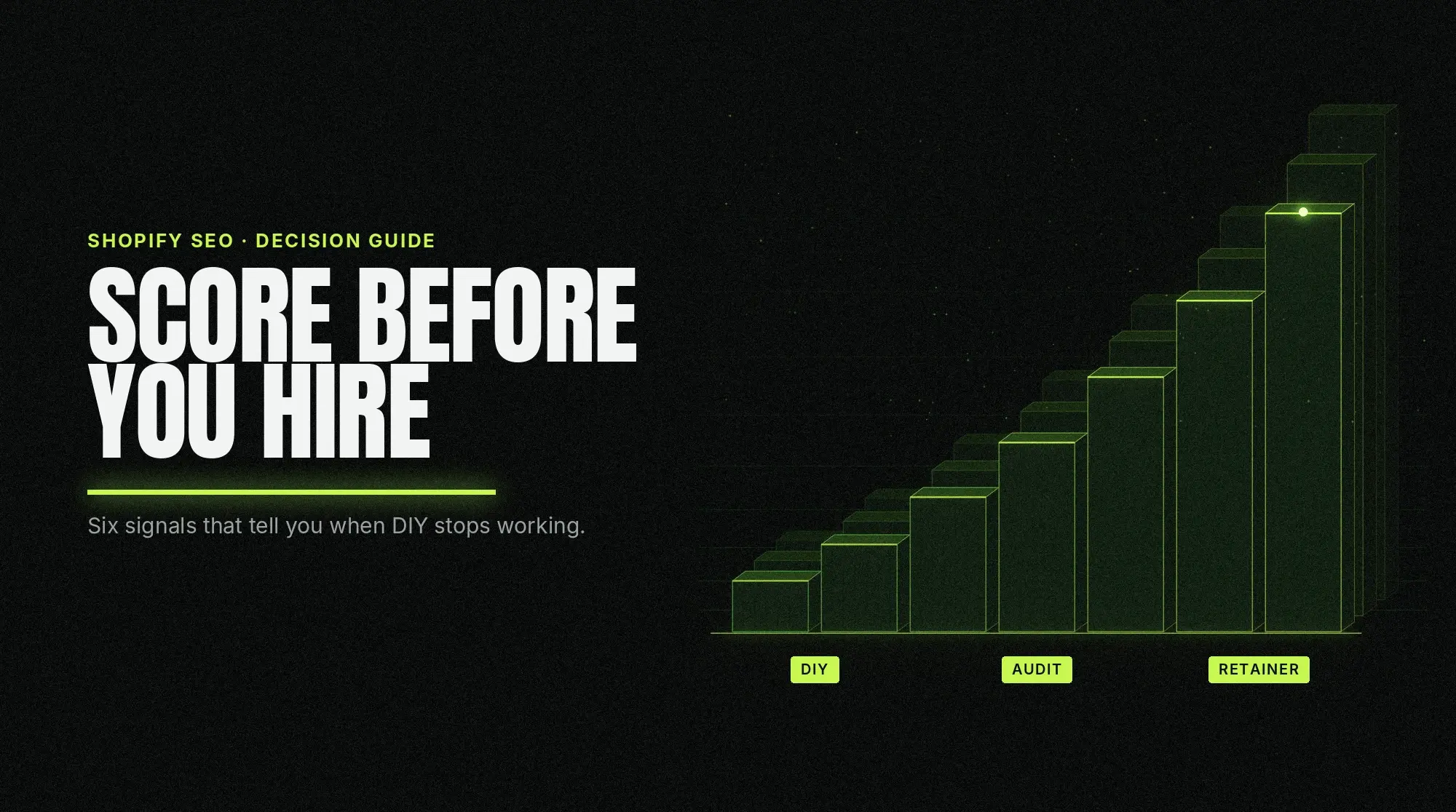
Hire a Shopify SEO expert when two or more of these six signals apply; below two, the DIY floor covers most of the work. This is our scoring rule, not an industry standard.
- A migration or URL-changing theme rebuild inside 90 days: Every changed URL needs a redirect, which Google’s site move guidance says to keep for at least a year. Still scoping the rebuild? See how our website development team plans redirects.
- Organic traffic or revenue down 20% or more, with no seasonal cause: Compare the same weeks year over year in Search Console. Finding the cause is expert work.
- A large or faceted catalog, meaning 1,000+ SKUs or crawled filter URLs: Google warns that crawl time spent on faceted navigation URLs leaves less for new pages.
- Selling in more than one market through Shopify Markets: Shopify adds hreflang tags, yet the domain structure and translations are yours. A wrong structure is costly to undo.
- Organic search is a top-two revenue channel, and nobody owns it: The channel needs one person reading Search Console weekly. Without one, drops surface a month late.
- Thin product data in AI channels: Shopify Catalog sends your product data into AI chats, and Google reads the same data on your product pages. Thin data costs you in both.
Count your signals, then read the table.
| Signals that apply | What to buy |
|---|---|
| 0 to 1 | The DIY floor, plus one-off help for a single signal |
| 2 to 3 | A one-time audit or a fixed project |
| 4 or more | A retainer |
Score first, then buy.
Shopify SEO Consultant vs. DIY vs. Freelancer vs. Agency (Compared)
Five models can do Shopify SEO work, each with a different weak spot.
| Model | How you pay | What you get | What it cannot do | Best fit |
|---|---|---|---|---|
| DIY | Owner hours plus app fees | Full control | Plan a migration or diagnose a sudden drop | 0 to 1 signals |
| Shopify SEO freelancer or specialist | Hourly, per Upwork’s cost page for SEO experts | One task, done to spec | Set priorities | A known task |
| Shopify SEO consultant | One-time audit or retainer | Diagnosis and direction | Make fixes without your team | 2 or more signals |
| Shopify SEO agency | Retainer covering a team | Plan plus execution | Match a consultant on cost | Shopify Plus stores, or 4 or more signals |
| Shopify Growth Services | Not published | Shopify’s own team | Show a price before a discovery call | Merchants wanting Shopify’s team |
If you run a Shopify Plus store with procurement rules, our enterprise SEO consultant procurement checklist covers retainer, project, and part-time terms. Match the model to your signal count.
What Drives the Cost of a Shopify SEO Consultant in 2026
A Shopify SEO consultant’s price follows scope, whether you buy an audit, a retainer, or a project.
An audit quote moves with catalog size and app count. A content retainer moves with pages written each month. A multi-market or Shopify Plus program moves with markets and languages. A migration moves with URL count and theme changes.
Whoever you hire, from a freelancer to the SEO expert Shopify itself employs, ask for the quote in deliverables, not hours. If a retainer quote exceeds what organic search earns you in a quarter, buy the audit, not the retainer.
How to Vet a Shopify SEO Expert: 8 Questions to Ask
Shopify SEO experts should clear eight questions before you sign. If you are working out how to hire Shopify SEO marketing experts, start with Google’s “Do you need an SEO?” page, which supplies the first two and suggests asking how each expert reports every change.
- Can you show past Shopify work, and do you follow Google Search Essentials? A good answer names the store type, the problem, and the metric that moved.
- What results should we expect, and when? A good answer names early metrics and a range of months.
- How do you handle collection-scoped product URLs? A good answer names the canonical tag and where product cards link.
- Which apps would you remove first, and why? A good answer names a speed test to run before cutting any app.
- Can you show a redirect map from a past migration? A good answer names old URLs, new URLs, and test results.
- Can you work in Liquid, or do you need a developer? A good answer names which edits they make themselves.
- What access do you need, and why? A good answer names a collaborator account and read-only Search Console access.
- How will you measure AI-channel referrals? A good answer names the analytics source and the AI platforms tracked, such as ChatGPT and Perplexity.
Three weak answers mean that you keep looking.
Red Flags: How to Spot a Bad Shopify SEO Expert
Bad Shopify SEO experts reveal themselves in the sales process, long before rankings move.
- Ranking guarantees: Google states, “No one can guarantee a #1 ranking on Google.”
- A request for your owner login: Shopify’s collaborator accounts let you approve only the permissions the work needs.
- Apps prescribed before any audit: An app automates one task, such as image compression, and adds scripts that can slow pages.
- Link packages: Google’s spam policies list buying or selling links for ranking purposes as link spam.
- No redirect map before a migration: Without one, every changed URL can send its traffic to an error page.
- A cold email claiming your store “has SEO errors”: Every crawler finds warnings, so an unsolicited report is a sales tactic, not a diagnosis.
One flag is worth a question. Two mean that you walk away.
AI Search and Agentic Storefronts: What Changes the Hiring Decision in 2026
AI shopping channels raise the value of clean product data more than that of on-page tweaks, which changes what a Shopify SEO consultant should audit first.
Shopify announced Agentic Storefronts in December 2025, and its March 2026 rollout reached ChatGPT, Microsoft Copilot, AI Mode in Google Search, and the Gemini app. Shopify Catalog supplies the product data, and you stay merchant of record. Shopify’s own Q1 2026 AI search data shows that 55% of AI-referred sessions start on a product page, against 20% for organic search.
A consultant should check product data, keep your policies and FAQs current in Shopify’s Knowledge Base app, and set up AI-referral measurement. If you want the full playbook, our guide to generative engine optimization covers what works, and our AI search optimization service makes your business clearer to AI assistants. Fix product data first.
Conclusion
That theme launch is only one signal. Run the DIY checklist first, score your store on the six signals, and buy the model your score points to.
Buy an audit before a retainer. Keep the owner login to yourself. Hire Shopify SEO expert help only when the score says so.
Do that, and every invoice covers a fix you needed.
If you want a straight answer on whether your store needs outside help, book a free 30-minute Shopify SEO call. We’ll score your store on the six signals, flag the three fixes worth doing first, and tell you whether DIY is enough or a Shopify SEO consultant is worth the fee. Book your call here. We’re happy to tell you when another agency is the better fit. If you’d rather skip the call, start with our free website and SEO audit.
FAQs
Is Shopify good for SEO?
Yes, for the basics. Shopify generates your sitemap.xml automatically, and its themes include product structured data by default. The real limits are the fixed /products/ and /collections/ paths, robots.txt.liquid edits that Shopify calls unsupported, and app code that slows pages. Most stores can work inside those limits without paying anyone.
Is Shopify bad for SEO?
No, though Shopify is rigid. You cannot remove the /products/ or /collections/ prefixes, and apps can add scripts that slow product pages. Those limits rarely block rankings. They turn costly when problems stack up, such as a migration plus new markets. That is when hiring a Shopify SEO expert pays off.
Do I need a Shopify SEO consultant?
Only if two or more of six hiring signals apply. They are a migration inside 90 days, an unexplained organic drop, a large or faceted catalog, multiple markets, organic search that nobody owns, and thin product data in AI channels. Hire Shopify SEO expert help at two or more. Below two, DIY usually works.
How much does a Shopify SEO consultant cost?
There is no fixed rate, since cost follows scope. A one-time audit costs less than a monthly retainer with content, and a migration is usually priced as its own project. Catalog size, app count, and market count affect a quote most. Compare proposals on deliverables, and buy an audit before a retainer.
Can I do SEO on Shopify myself?
Yes, most owners can. Submit the sitemap in Google Search Console, write unique titles and descriptions for top products and collections, replace manufacturer copy, add image alt text, redirect broken URLs, and remove unused apps. That covers the basics. Get help when a migration looms or two problems stack up at once.
What is the difference between a Shopify SEO consultant and an agency?
A consultant diagnoses and directs, while an agency diagnoses and executes. A Shopify SEO consultant audits a store, ranks fixes by revenue impact, and hands priorities to your team or developer. An agency adds writers, developers, and link outreach under one retainer, so it costs more and suits stores with no in-house team.
Should I give an SEO consultant access to my Shopify store?
Yes, through a collaborator account, never your owner login. Shopify lets you approve only the specific permissions the work needs, and collaborators do not count toward your store’s user limit. Google’s own hiring guidance adds that an auditor needs read access to Search Console, not write access, at the audit stage.
Does Shopify SEO still matter if shoppers use ChatGPT?
Yes, because search and AI shopping now overlap. By March 2026, Shopify Agentic Storefronts reached ChatGPT, Microsoft Copilot, AI Mode in Google Search, and the Gemini app through Shopify Catalog. Clean product titles, descriptions, policies, and structured data feed both Google and those AI channels, so the same work pays off in two places.
Related Reading
- If your company buys SEO through a formal procurement process, Hiring an Enterprise SEO Consultant: A Procurement Checklist for 2026 sets out the contract terms to insist on.
- If AI answers are your next channel, Generative Engine Optimization (GEO): What Works separates the proven steps from the unproven ones.
- If you want data on what AI engines cite, How to Rank in ChatGPT, Gemini, and Perplexity in 2026 reports patterns from 50 business sites.
- If you want the same DIY-then-hire pattern applied to a local trade, Roofing SEO: A Do-It-Yourself Guide for Roofers shows where owner work ends and paid help begins.