AI Smart Contract Audit Tools vs. Human Auditors: What the Scanners Miss in 2026
You have a contract two weeks from mainnet, an audit quote in one tab, and an AI tool in the other promising the same result in minutes at a subscription price.
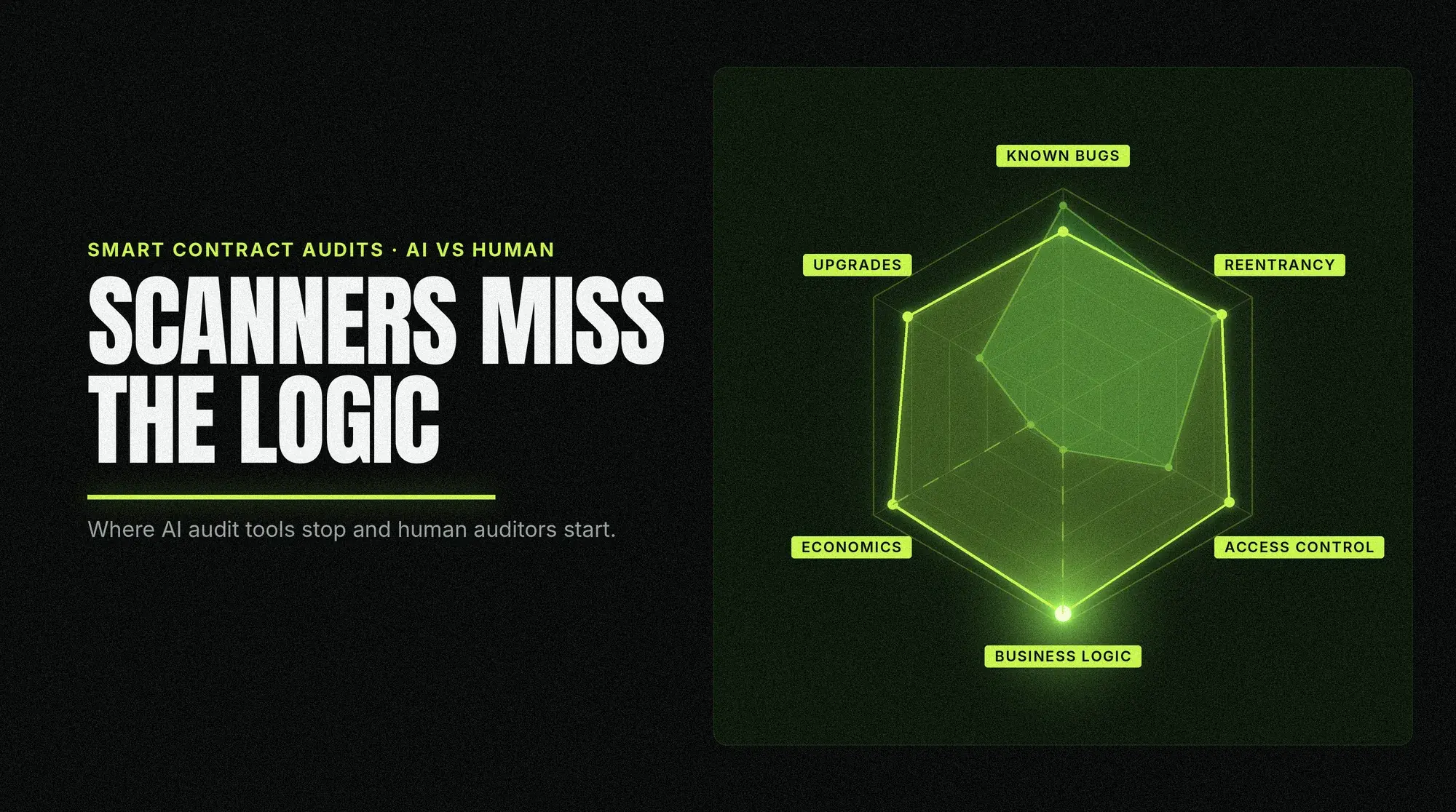
The promise is half true. An automated smart contract audit flags reentrancy patterns, unchecked return values, and unprotected functions faster than anyone. It cannot judge whether the code does what your protocol is meant to do, and that judgment is the core of what a smart contract audit covers.
The other half is expensive. On November 3, 2025, attackers drained more than $100 million from Balancer v2 through a rounding direction error in the pool’s math, not a textbook code pattern.
We read the published benchmarks, studies, and post-mortems to show where each tool stops, what false positives cost, and how to spot a scan sold as an audit. A scanner is a first pass, not the audit.
Key Takeaways
- An automated smart contract audit catches known code patterns in minutes and misses most of the business logic flaws behind large losses.
- In a peer-reviewed 2024 study, five automated security tools could have prevented 8% of 127 real attacks, or $149 million of $2.3 billion in losses.
- In AI smart contract security, agents attack better than they review. On the EVMbench benchmark, the best agent scored 71.0% on exploit tasks, and the best detector found 45.9% of known vulnerabilities.
- Nine analysis tools tagged 97% of 47,518 Ethereum contracts as vulnerable in a 2020 study, so a free scan still costs engineers hours spent on false positives.
- Scan first to clear cheap findings, then pay a human auditor for business logic, integrations, and trust assumptions.
Table of Contents
- What “Automated Smart Contract Audit” Actually Means in 2026
- How We Reviewed the Evidence (Methodology)
- What an Automated Smart Contract Audit Catches: The Published Results
- What the Scanners Miss: The Vulnerability Classes That Need a Human
- False Positives: The Cost Nobody Prices In
- Where AI Tools Beat Human Auditors
- Automated Smart Contract Audit vs. Human Audit vs. Hybrid
- Red Flags: When an “Audit” Is Really a Scanner Report
- Conclusion
- FAQs
- Related Reading
What “Automated Smart Contract Audit” Actually Means in 2026
An automated smart contract audit is a software-run security scan that matches code against known vulnerability patterns, generates test inputs, and checks stated properties, without human review. It is a scan for known patterns, not a review of intent.
Four techniques do the work. Static analysis matches patterns, fuzzing generates inputs, symbolic execution and formal verification together check properties, and a large language model (LLM) agent reasons over code in plain language. Each one compares your code with something already written down, such as a rule, a property, or a past exploit.
Unwritten rules mostly go unchecked.
An AI smart contract audit is an automated audit that runs on a language model. When a vendor says “AI audit,” ask which of the four techniques it runs. This article keeps the word “audit” for the scoped human engagement that ends in a signed report, and our definition post explains what a smart contract audit is.
Static Analyzers vs. Fuzzers vs. Formal Verification vs. LLM Agents
Smart contract security tools fall into four types, each with a different blind spot. The table adds the tools a vendor is most likely to name.
| Tool type | How it works | What it finds | What it cannot see | Example tools |
|---|---|---|---|---|
| Static analyzer | Reads code without running it and matches known patterns | Reentrancy, unchecked low-level calls, and unprotected upgrades | Any flaw with no rule written for it | Slither, Aderyn |
| Fuzzer | Runs code with generated inputs against properties a human wrote | Call sequences that break a stated property | Anything the properties do not describe | Echidna, Medusa, Foundry invariant tests |
| Symbolic execution and formal verification | Proves or breaks stated properties across inputs, within set bounds | Violations that no test input reached | Business intent missing from the specification | Mythril, Halmos, Certora Prover |
| LLM agent | Reasons over code, comments, and documentation in natural language | Mismatches between the documentation and the code | Its own errors, which vary between runs | Nethermind AuditAgent, general-purpose AI models |
The LLM agent category moves fastest. Two public benchmarks, covered in the results below, now measure AI agent smart contract exploit generation.
How We Reviewed the Evidence (Methodology)
In October 2026, we reviewed what each type of smart contract audit tool catches by reading two public AI benchmarks, three peer-reviewed tool studies, one vendor case study, and five exploit reports. This is a review of published evidence, not a lab test of our own, so every cited figure links to its source.
We counted a benchmark or study only if it named its tools, its dataset, and its date.
Limits. Every benchmark and study here covers Solidity and the Ethereum Virtual Machine (EVM), and new model releases move the AI figures within months, so read each number as true for its date. If your contracts are written in Rust or Move, the tooling and the review change, and we cover how in our guide to Solana, Move, and EVM audits.
No tool maker paid to be included, and none saw this article before publication.
What an Automated Smart Contract Audit Catches: The Published Results
Automated tools detect a minority of real vulnerabilities, and the share depends on whether the flaw matches a pattern someone has already described. That holds even for the best smart contract audit tools, as the four published sources in the table show.
| Published source | What was tested | What the tools caught | What the tools missed |
|---|---|---|---|
| Zhang et al., 2023 | Tool techniques classified against 462 contest findings and 54 real exploits | Under one in five exploitable bugs | More than 80%, which the authors place “beyond existing tools” |
| Chaliasos et al., 2024 | 5 security tools against 127 real attacks | 8% of the attacks, worth $149 million | 92% of the attacks, worth about $2.15 billion |
| EVMbench, 2026 | AI agents on 117 vulnerabilities from 40 audits, with 44 set up for patching and 23 for exploiting | Best scores of 45.9% on detect (Claude Opus 4.6), plus 41.7% on patch and 71.0% on exploit (GPT-5.3-Codex) | More than half of the 117 in detect mode |
| Anthropic’s red team research, December 2025 | 10 AI models on 405 contracts exploited between 2020 and 2025 | Working exploits for 207 contracts, or 51.11% | The other 198 contracts |
EVMbench scores agents on finding a flaw (detect), fixing it (patch), and draining funds through it (exploit). GPT-5.3-Codex scored 71.0% in exploit mode against 33.3% for GPT-5, released about six months earlier. In Anthropic’s test of AI agent smart contract exploit generation, the models took $4.6 million in simulated funds from contracts hacked after their training data ended.
Scanners work best on known patterns. In the Chaliasos study, every preventable attack was a reentrancy attack. Human auditors had already reported all 117 of EVMbench’s smart contract vulnerabilities, and its best detector missed more than half. Detection lags far behind exploitation.
What the Scanners Miss: The Vulnerability Classes That Need a Human
The smart contract vulnerabilities that scanners miss share one trait. Finding them requires knowing what the contract is supposed to do.
Business Logic and Economic Design Flaws
A business logic flaw is code that runs as written while the design is exploitable. Reward math, liquidation thresholds, and rounding direction all sit in this class.
Trail of Bits traced the Balancer v2 exploit of November 2025 to a rounding direction error that let attackers drain more than $100 million across nine networks. No scanner rule limits how far a pool may round in the trader’s favor. A person has to write that limit down as an invariant, a rule that must always hold, before invariant testing can find the input that breaks it. Trail of Bits adds that its own 2021 review flagged the rounding pattern without proving it exploitable.
Human review has limits too. Ask whether economic review is in scope since many audits check that the code implements your model without stress-testing it.
Cross-Contract and Composability Risk
Composability risk is the exposure a contract takes on from code it calls but does not control. That exposure runs through every external integration, flash loan path, and callback.
Penpie lost an estimated $27 million in September 2024 after an attacker created a fake market on Pendle, the protocol Penpie integrated with, and used that market to re-enter Penpie’s reward function. A scanner can flag a missing reentrancy guard. It cannot know that anyone could create the market at the other end of the call. A smart contract auditor asks who is allowed to deploy it. Scope the integrations, not only the files.
Oracle and Price Manipulation
A price feed, called an oracle, can be correct in code and still be manipulated in the market. Chainalysis estimated that decentralized finance protocols lost $403.2 million in 41 oracle manipulation attacks in 2022. One of the biggest drained $117 million from Mango Markets, a Solana exchange, that October.
No line of code is malformed in an attack like that. The oracle reports the price it sees, and the attacker has already moved it in a thin market. A static scanner cannot see liquidity depth, because liquidity is not in the code. A human auditor asks who can move this price, at what cost, and how fast.
Access Control Intent and Privileged Roles
Tools catch unprotected functions and miss wrong trust assumptions. An admin key that can drain funds by design draws a generic warning at best because the code works as written.
Radiant Capital lost an estimated $53 million in October 2024 after attackers obtained the three signatures its 11-key admin wallet required, took control of a core contract, and upgraded the lending pools to a malicious version. No function was unprotected. The protection rested on three keys.
A human reviewer maps every privileged function to the addresses that can call it, and our scope guide explains what an audit does and does not cover on privileged roles. List the keys, then assume enough are stolen.
Upgrade, Initialization, and Off-Chain Components
Upgrade risk lives in the steps around the code, including proxy upgrade paths, initializer functions, deployment scripts, keepers, and signers. Most of those sit outside the files a scanner reads.
In August 2024, the Ronin bridge lost $12 million after a contract upgrade ran one of two initialization functions and skipped the other, which left the vote weight needed to approve a withdrawal at zero. White-hat operators later returned the funds. The flaw was in how the upgrade ran, not in a line a pattern rule would match.
A human auditor reviews the upgrade plan as a sequence and asks what state each step leaves behind. Audit the rollout as well as the code.
False Positives: The Cost Nobody Prices In
Scanners also fail in the other direction. A false positive is a finding that is not a real vulnerability. In a 2020 academic study, nine tools tagged 97% of 47,518 Ethereum contracts as vulnerable, which the authors read as a considerable number of false positives. EVMbench does not measure the problem, since its authors state that agents can submit false positives without penalty.
The real cost of a free scanner is the engineer time spent proving its false findings wrong. Take a scan that returns 60 findings, 6 of them real. At 15 to 20 minutes to check and dismiss each of the other 54, triage takes 13.5 to 18 engineer hours. Those counts are an illustration, so swap in your own.
Nethermind, which sells an AI audit tool, says in its own review of that tool that “AuditAgent still produces noise that requires expert filtering.” Alert fatigue costs more than the hours. A team that learns to ignore scanner output also ignores the real findings. Budget for triage.
Where AI Tools Beat Human Auditors
None of that is an argument against the tools. Scanners and AI smart contract security agents beat human auditors on speed, cost per run, consistency, and reach.
- Speed. Slither’s documentation cites an average execution time of less than 1 second per contract.
- Cost per run. Slither and Aderyn are free, so a scan can run on every commit, while a human audit covers one frozen commit.
- Consistency. A static analyzer applies every rule to every line, though an LLM agent varies between runs.
- Reach. In Anthropic’s research, two AI agents scanned 2,849 recently deployed contracts with no known vulnerabilities and found two new flaws. The exploits were worth $3,694, and GPT-5’s run cost $3,476.
Smart contract audit AI works best as cleanup before the audit. Clear the cheap findings first, and paid auditor hours go to logic. Nethermind ran its AI tool on 29 of its own audits and found that it had identified 30% of the findings its human auditors made. That is a head start, not a replacement.
Automated Smart Contract Audit vs. Human Audit vs. Hybrid
An automated scan checks the code against known patterns. A human audit checks it against what the protocol is meant to do. The table compares the three options on what a buyer receives and what drives the cost.
| Factor | Automated scan | Human audit | Hybrid |
|---|---|---|---|
| What drives the cost | A subscription or compute, plus your triage hours | Auditor hours, set by code size, complexity, and language | Auditor hours on logic, once tooling clears known patterns |
| Turnaround | Minutes to hours per run | Days to weeks | Days to weeks, with scans on each commit |
| Vulnerability classes covered | Known patterns and stated properties | Patterns plus logic, integrations, and privileged roles | Patterns by tooling, intent by people |
| Output you receive | Findings with tool identifiers | A report with severity ratings, a proof of concept for each serious finding, and fixes | One report, with every tool finding confirmed by a person |
| Who signs the report | Nobody | Named auditors | Named auditors |
| When it is the right call | On testnet prototypes and every commit | Before mainnet with user funds and after every upgrade | At the same moments as a human audit, with tooling run first |
Nethermind’s tool missed 70% of its auditors’ findings. A smart contract auditor spends the paid hours on that gap, modeling threats, reading the specification against the code, and deciding which findings are real.
Hybrid is how serious firms work. Trail of Bits and Cyfrin maintain open-source smart contract audit tools, including Slither, Echidna, Medusa, and Aderyn, yet both sell human review.
If you are comparing proposals, our smart contract audit page lists what to have ready for a first conversation. If AI wrote the app around your contracts, our free vibe coding security audit has a person test it from the outside.
Ask each firm on your shortlist how its hours are split between tooling and manual review.
Red Flags: When an “Audit” Is Really a Scanner Report
Some low-cost “audits” are scanner output with a logo on top, and five signs give them away. Each comes with a question for the sales call.
- A turnaround of under 72 hours on a large codebase. Ask, “How many hours of manual review does that include?”
- Findings with tool-style identifiers and no proof of concept. Ask, “Can you show me the exploit for your highest-severity finding?”
- No named auditors. Ask, “Who reviewed this, and which findings did each person file?”
- No business logic findings at all. Ask, “Which of our protocol’s rules did you test, and where are they written down?”
- No retest. Ask, “Do you verify our fixes, and is that inside the scope?”
One flag is worth a question. Three mean you are buying a scan.
The opposite fails too. A human-only firm that runs no smart contract security tools bills hours for findings a scanner returns in seconds. If you are building a shortlist, we name 10 firms in our comparison of smart contract audit firms.
Conclusion
Keep both tabs open. Five tools could have prevented 8% of 127 real attacks, and the classes they miss need a person who knows what the contract is meant to do.
Scan first. Fix the cheap findings. Write down the properties for invariant testing. Pay humans for logic. Re-audit after every upgrade.
Do that, and the scan becomes the cheapest line in your security budget, not the only one.
If you’ve already run an automated smart contract audit and want a person to read what it flagged, book a free 30-minute audit scoping call. We’ll read your scanner output, list the contracts that need a review, and tell you what a human audit should cover. Book the call here.
FAQs
Can AI replace my smart contract audit?
No. AI and automated tools replace an audit’s first pass, not the audit. In a peer-reviewed study of 127 real attacks, five tools could have prevented 8%, and the best AI detector on the EVMbench benchmark found 45.9% of known vulnerabilities. Clear known patterns with tools, then pay humans for logic.
What does an automated smart contract audit actually catch?
Known code patterns. Static analysis flags reentrancy patterns, unchecked return values, and unprotected functions, and fuzzing finds inputs that break properties you have written down. Both test your code against something already stated, so an automated smart contract audit finds vulnerabilities already described and misses those unique to your protocol’s design.
What are the best AI tools for smart contract auditing in 2026?
No single tool leads everywhere. On EVMbench, a benchmark published in February 2026, Claude Opus 4.6 led at detecting vulnerabilities, and GPT-5.3-Codex scored highest at patching and exploiting them. Run one static analyzer and one fuzzer on every commit, and treat any AI agent as a second reader, not a sign-off.
Is a free smart contract audit tool enough before I launch?
Not if your contract will hold user funds. A free smart contract audit tool such as Slither or Aderyn is worth running throughout development because it flags cheap-to-fix issues early. Neither judges design, integrations, or the trust placed in admin keys. A clean scan means only that no known pattern matched.
How do I audit a smart contract myself?
Start with tooling, then test your assumptions. Run a static analyzer, write a property for every rule your protocol must never break, and fuzz the contract against those properties. Document who can call each privileged function. That is how to audit a smart contract yourself, and it shortens a paid audit without replacing it.
How often should my smart contracts be audited?
Every time the deployed logic changes. Audit before the first mainnet deployment, re-audit after every upgrade, especially around fund flows or access control, and run automated scans on every commit in between. A human audit covers one frozen commit. Code changed after that commit is unaudited, whatever the old report says.
How much does a smart contract audit cost compared with an AI tool?
A human audit costs far more per engagement than a tool subscription. Auditor hours drive the audit price, while a scanner costs a subscription or compute plus your own triage time. The useful comparison is the cost per real finding after false positives are removed. Ask each vendor what drives its quote.
What is the difference between an automated smart contract audit and a manual review?
The difference is what the code gets checked against. An automated smart contract audit compares code with known patterns and stated properties, often within minutes. A manual review compares it with what your protocol is meant to do, covering business logic, integrations, and privileged roles, and ends in a signed report.
Related Reading
- If you are scoping a human review, our smart contract audit page lists what to have ready for the first conversation.
- If you need the definition first, What Is a Smart Contract Audit? A Plain-English Definition for Founders gives it in one sentence.
- If you are choosing a vendor, Best Smart Contract Audit Firms in 2026: An Honest Comparison covers 10 firms.
- If your contracts are not on the EVM, read Solana, Move, and EVM Audits Are Not the Same Job: A Chain-by-Chain Guide for how the review changes.